

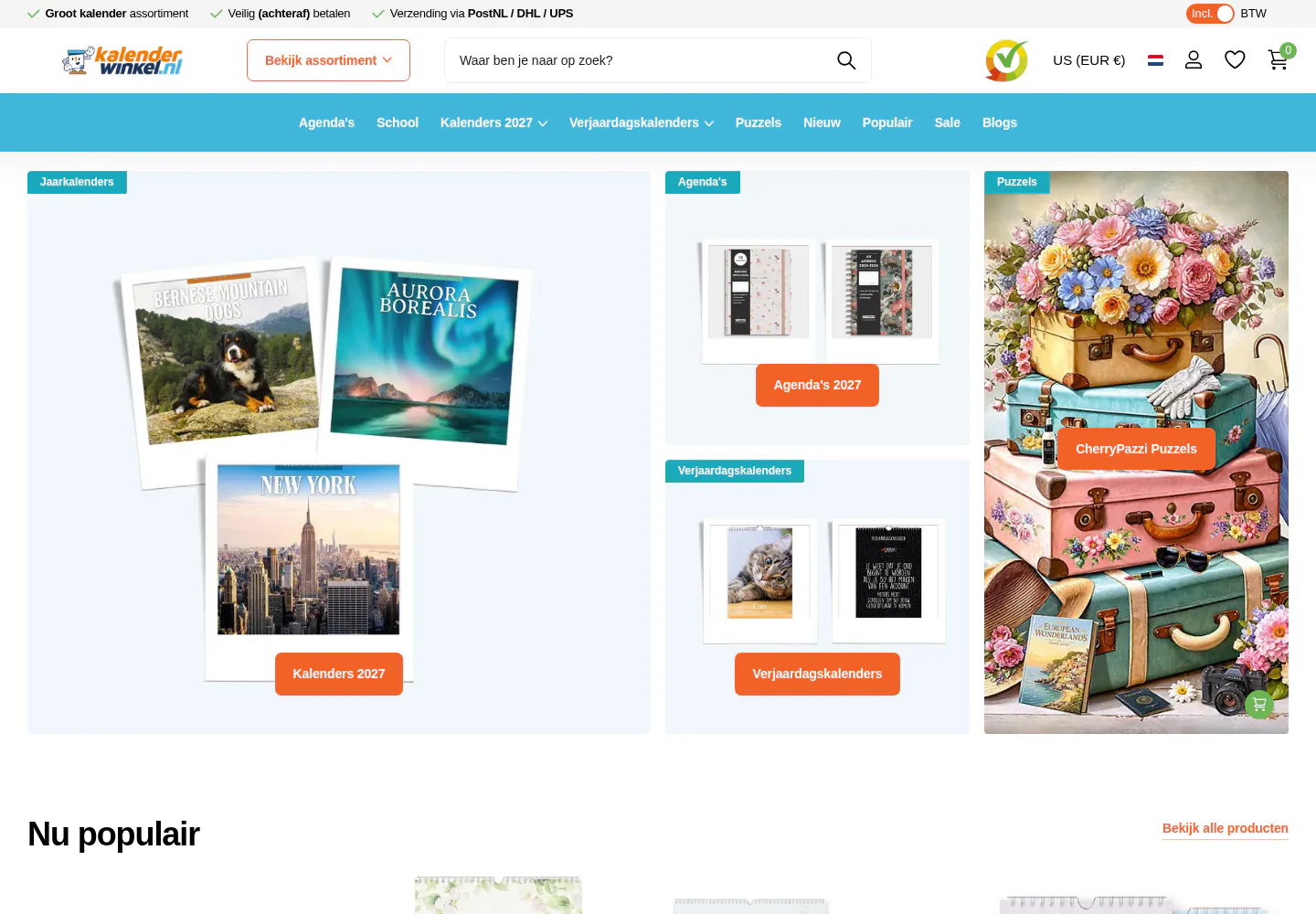
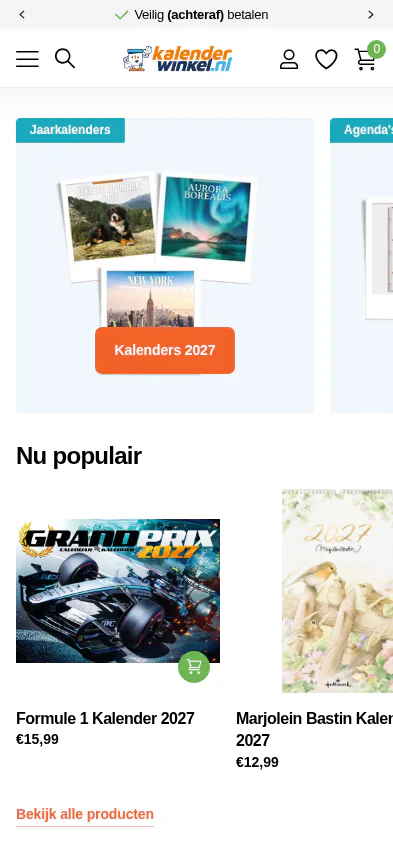
Where Kalenderwinkel started
Kalenderwinkel.nl is the specialist in calendars and agendas, from birthday and tear-off calendars to wall calendars and planners. Order before 16:00 and your order ships the same day, with a huge collection to choose from for every theme and style.
Kalenderwinkel ran two separate shops and wanted to professionalise the setup without giving up the existing structure. The brief was to bring data from two sources into two clean Shopify environments and support seven languages.
- 01Two separate Lightspeed shops
- 02Data from two sources that had to land in two Shopify environments
- 03More than one million entities across products, variants, collections, customers, orders and content
- 04Seven languages with clear locale structures and consistent slugs
- 05A client team that owned visual design and Shopify back-office configuration
Kalenderwinkel ran two separate stores and wanted to professionalise that setup without letting go of the existing structure. The brief: bring data from two sources together, support seven languages and deliver two cleanly set-up Shopify environments: while the team takes care of design and back-office configuration themselves.
The migration approach
Syncer ran a complete data migration in which more than a million entities were carefully migrated. That includes products and variants, collections, customers, orders and content. Mapping, normalisation and quality checks ensured data from both shops slotted seamlessly into the Shopify data structure of the two target environments.
Seven languages without noise
The multilingual catalogue was set up across seven languages, with clear locale structures and consistent slugs. This keeps navigation and findability logical per language, and gives customers in every country the same clear experience tuned to their language.
Collaboration on their own terms
Kalenderwinkel took the lead on visual design and the Shopify back office themselves. Syncer delivered the data layer and technical orchestration; the client team used that base to configure theme, content and settings exactly to their liking. The result was an efficient split: Syncer for the migration core, Kalenderwinkel for brand and operations.
The result
Two Shopify stores now run on cleaner data, with seven languages consistently implemented and a frontend refined by the in-house team. Management is clearer, expanding per language or market is easier and the customer experience is uniform across both sites.
How the migration ran
Syncer handled the data layer while Kalenderwinkel led the store setup.
Discovery
The migration covered two source shops, two Shopify environments and seven languages. The split of responsibilities was set early: Syncer handled the migration core while Kalenderwinkel owned design and back office.
Data migration
More than one million entities were migrated. Products, variants, collections, customers, orders and content were mapped, normalised and checked before landing in the two Shopify environments.
SEO migration
The multilingual catalog received clear locale structures and consistent slugs. That kept navigation and findability logical for each language.
Storebuild
Kalenderwinkel took the lead on visual design and Shopify back-office configuration. The team used the migrated data layer to set up theme, content and settings in its own way.
Go live
Two Shopify stores now run on cleaner data with seven languages consistently implemented. The migration went live on 8 April 2024.